
The Great Reading Debate
For years, readers have debated: Does listening to an audiobook count as real reading?
Purists argue that physical text demands deeper concentration and yields superior critical thinking. Audiobook fans counter that listening allows them to absorb 50 books a year while commuting, walking their dog, or cooking dinner.
Neurological brain scans reveal that both sides are partially right—and that the real breakthrough comes from marrying the two.
Visual Reading: Strengths and Limitations
The Pros:
- Spatial Anchoring: Physical pages provide a tactile topography that helps your brain map where arguments live in a book.
- Pacing Control: You can pause on a difficult word, re-read a complex sentence, or inspect diagrams at your own speed.
The Cons:
- Sub-vocalization Drag: Most adults can only read visually as fast as they can speak internally (approx. 200–250 words per minute).
- Distraction Vulnerability: Fatigue easily causes eye wander, skipped paragraphs, and daydreaming.
Audiobooks: Strengths and Limitations
The Pros:
- Unrivaled Convenience: You can consume books in scenarios where holding a book or looking at a screen is physically impossible.
- Emotional Prosody: A skilled narrator infuses tone, irony, and emotional nuance into character dialogues and storytelling.
The Cons:
- High Mind-Wandering Rate: Without visual anchoring, auditory attention lapses frequently. You suddenly realize you haven't heard a word for the last 3 miles of driving.
- Difficult Highlighting & Note-Taking: Capturing an exact quote or bookmarking a technical diagram while driving or running is frustrating.
The Ultimate Solution: Bimodal Reading
Why choose between reading with your eyes and listening with your ears when your brain was wired to do both?
When you use NeuroRead Pro's Bimodal Mode, synchronized audio propels your reading pace forward while illuminated text anchors your visual focus. This eliminates the eye wander of visual reading and the mind-drifting of pure audio, resulting in double the retention in half the time.
Try reading with NeuroRead Pro's synchronized highlighting feature. It helps you stay focused by guiding your eyes and keeping you in the flow of the content.
Learn more about reading modes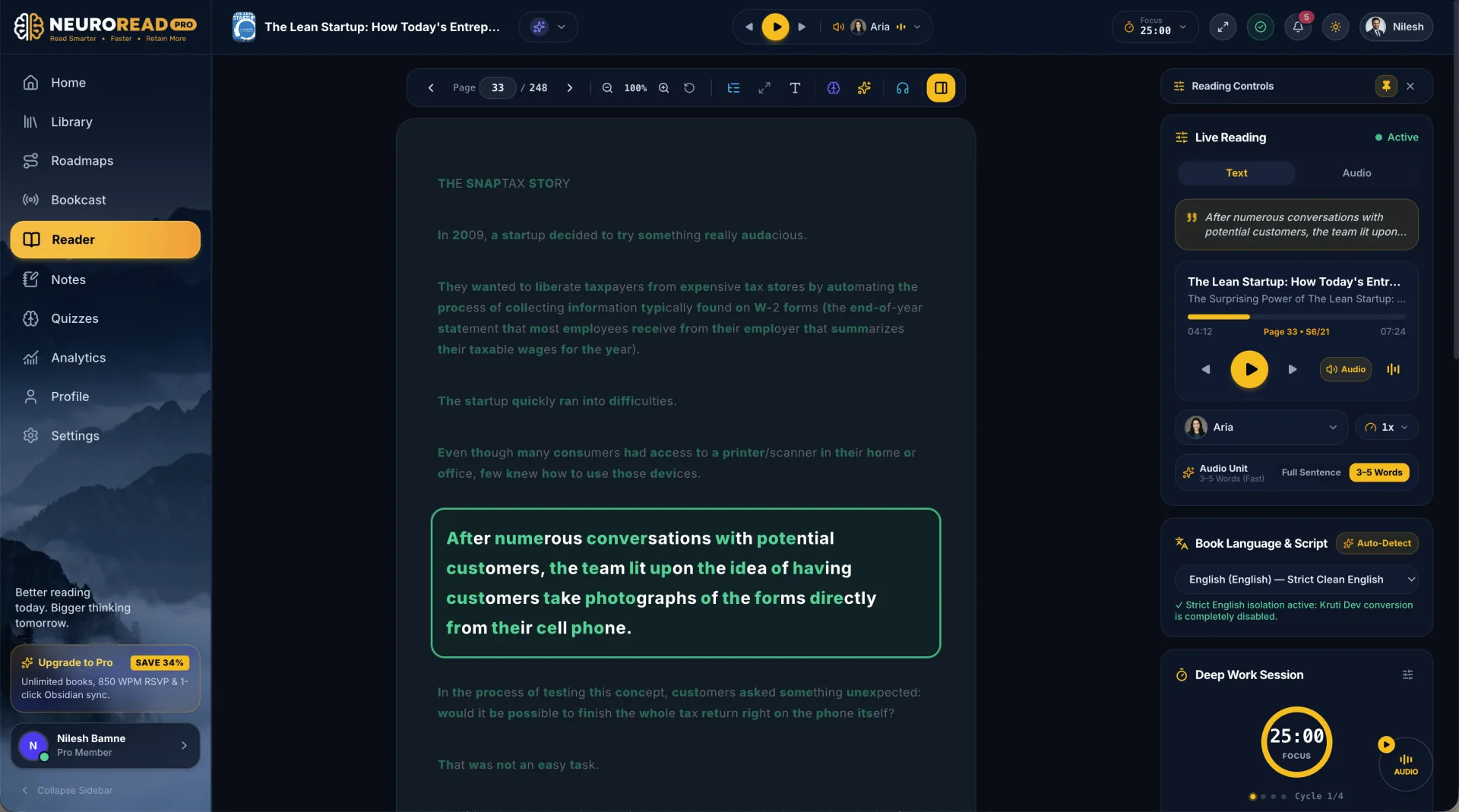
Key Takeaways
- Visual reading provides precise pacing control, while audiobooks provide unmatched mobility.
- Both formats suffer from attention leakage when used in isolation.
- Combining synchronized audio and visual text (Bimodal Reading) eliminates sub-vocalization drag and maximizes comprehension.